Updated 24 November 2026: a new section near the end covers what Ethiopia has put in place since this article was written in December 2024, including its national AI policy, data protection law, Digital Ethiopia 2030 strategy and first Amharic AI system.
As Generative artificial intelligence (AI) transforms industries, cultures, and entire economies worldwide, a key question emerges: Who controls its trajectory, and whose values does it serve? For Ethiopia, this question is especially urgent.
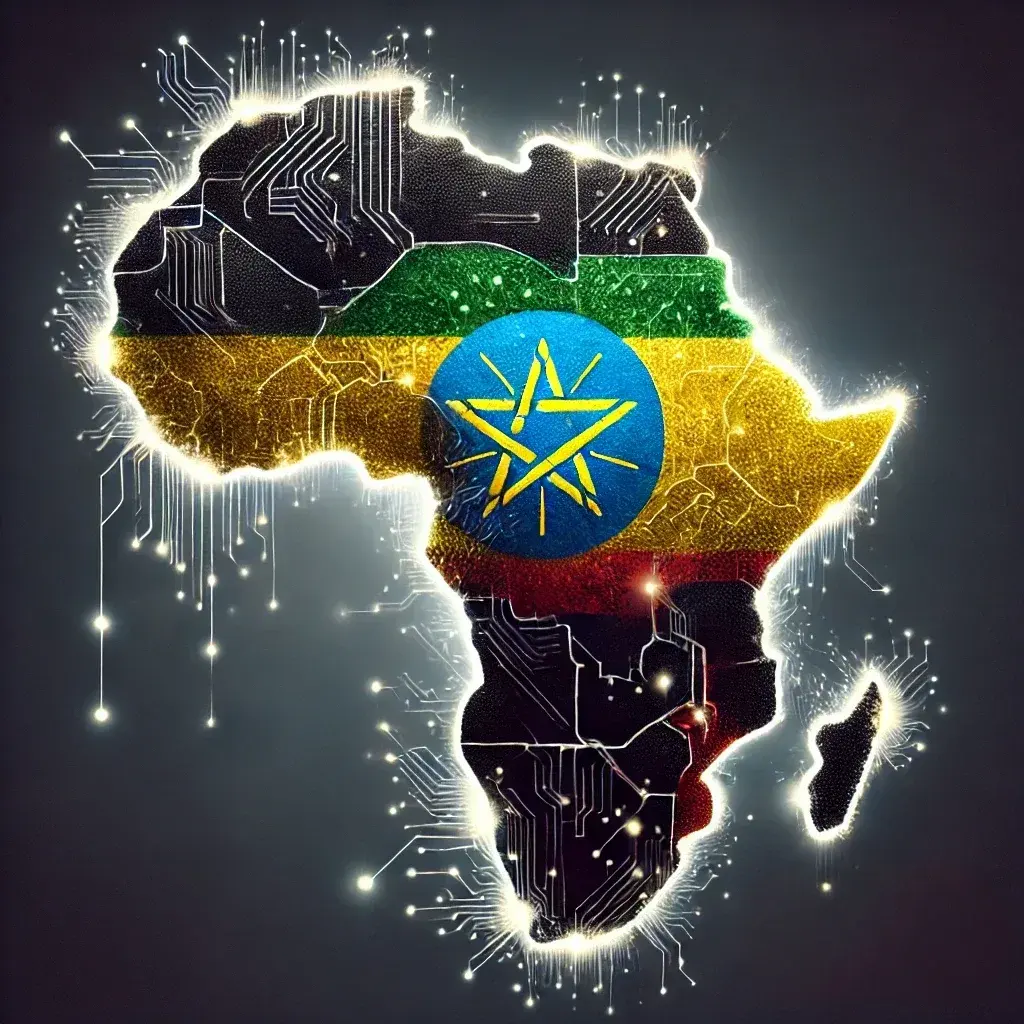
The country’s abundant renewable energy resources, forward-looking digital policies, and Climate-Resilient Green Economy (CRGE) Vision position it as a compelling hub for advanced generative AI computation. But beyond powering data centers, Ethiopia has an opportunity and a responsibility to shape AI on its own terms. By embracing “Sovereign AI,” Ethiopia can develop generative AI systems that speak its languages, reflect its cultural nuances, and drive equitable, sustainable growth. Ultimately, sovereign AI can help Ethiopia break entrenched cycles of poverty and pave the way for Africa’s broader digital transformation.
Foundations for Sovereign AI
Ethiopia’s foundations are already taking shape. The government’s Digital Ethiopia strategy, the Ethiopian AI Institute, and the Digital Transformation Council have collectively laid a policy and institutional framework conducive to innovation. The Ethiopian Capital Market Authority’s regulatory sandbox approach encourages experimentation, while the CRGE Vision ensures environmental sustainability is woven into every development decision. These policy, institutional support and green energy pillars form a launchpad for Ethiopia’s venture into AI sovereignty.
At the heart of this approach is Ethiopia’s wealth of clean, renewable energy. From hydroelectric dams to wind and solar resources, the country can power GPU clusters and next-generation compute centers sustainably. By hosting AI training workloads domestically rather than outsourcing them to distant data centers, Ethiopia can minimize emissions, reduce foreign dependencies, and maintain better oversight over data and models. This foundational advantage connects directly to the broader goal of shaping AI in alignment with local realities rather than relying on external sources.
Why AI Sovereignty Matters
Sovereign AI represents more than just technical autonomy; it is about ensuring AI systems are culturally resonant, contextually relevant, and aligned with long-term national development goals. When AI models are developed exclusively abroad, they often embed values, linguistic biases, and assumptions that may not translate to Ethiopian realities. Sovereign AI ensures that Ethiopia and other African nations are not mere consumers of AI shaped elsewhere, but active producers of technologies that incorporate local languages, traditions, and societal aspirations.
This cultural alignment builds trust, which is crucial if AI is to help solve pressing issues such as limited healthcare access, financial exclusion, and educational disparities. It also promotes inclusivity. Tailored AI solutions can address rural communities’ unique challenges, urban centers’ complexities, and the cultural particularities of diverse ethnic and linguistic groups. When deployed ethically and locally informed, AI has the potential to enhance social cohesion and ensure that technological progress does not leave the most vulnerable behind.
Open-Source Models and Indigenous Innovation
The journey toward sovereign AI does not need to start from scratch. In the near term, Ethiopia can leverage open-source generative AI models such as Meta’s Llama, Mistral AI’s Mixtral, NVIDIA’s Nemotron, or Alibaba's Qwen, and fine-tune them with local data. Universities, tech hubs, and entrepreneurial ventures can quickly build capacity, translating global advancements into Ethiopian contexts. This democratized innovation approach ensures that knowledge, tools, and capabilities spread across regions, empowering diverse communities to address their own challenges.
Over time, Ethiopia should aspire to develop truly indigenous AI models. Conceived and trained with Ethiopia’s priorities at the forefront, these models will incorporate local languages and cultural cues from the outset. By embedding Ethiopia’s development objectives directly into the technology, these proprietary models can yield long-term strategic advantages. They become powerful assets that not only serve the nation’s interests but also positions Ethiopia as a pioneering force in African AI. Furthermore, by incorporating other African languages and contexts, Ethiopia can encourage broader regional integration, fostering cultural and economic ties across the continent.
Tackling Poverty and Fostering Inclusive Growth
The potential of sovereign AI extends far beyond efficiency gains in existing sectors. It can directly address the systemic barriers that perpetuate poverty. At its core, poverty is about constrained access: limited energy, inadequate infrastructure, scarce financial services, weak healthcare systems, and poor educational opportunities. By tailoring AI to local realities, Ethiopia can systematically dismantle these barriers.
In finance, AI-driven credit scoring, microfinance recommendations and personalized customer support in local language can increase financial inclusion, bringing underserved communities into the formal economy. In healthcare, AI-assisted diagnostics, decision support tools for clinicians, and localized telemedicine platforms ensure equitable access to quality care, even in remote regions. In agriculture, predictive modeling of rainfall, soil health, and pest risks can boost agricultural productivity, enhance food security, and reduce vulnerability to climate shocks. Similarly, in education, personalized AI-driven learning tools can tailor curricula to individual learning paces and linguistic backgrounds, improving educational outcomes and empowering future generations.
By leveraging sovereign AI to expand access, Ethiopia can transform poverty from an intractable structural problem into an era-defining success story, where technology catalyzes inclusive and sustainable economic growth.
Policy, Governance, and Global Engagement
Realizing the promise of sovereign AI requires a balanced approach to governance and global collaboration. On the policy front, Ethiopia can continue refining its regulatory sandbox framework, allowing new AI applications to be tested, studied, and improved in all sectors of development. Clear ethical guidelines, data access and protection laws, and human-centric AI standards will help ensure safety, fairness, and accountability as the technology matures.
Regionally and globally, Ethiopia’s leadership can influence the formation of international norms and standards. By engaging with the African Union, the United Nations, and global think tanks, Ethiopia and other African nations can shape AI governance frameworks that reflect their values and interests. This collaborative stance is essential: while Ethiopia aims for sovereignty, it also stands to gain from strategic alliances that support responsible AI development and leverage shared learnings.
What Ethiopia Has Put in Place Since (November 2026)
Several of the foundations this article called for now exist:
- A national AI policy. Ethiopia’s Council of Ministers approved the country’s first National Artificial Intelligence Policy at its session on 27 June 2024, with the Ethiopian Artificial Intelligence Institute coordinating its implementation (Ethiopian News Agency via allAfrica).
- A data protection law. The Personal Data Protection Proclamation No. 1321/2024 sets out data subjects’ rights, principles for processing personal data and conditions for transferring it abroad, supervised by the Ethiopian Communications Authority (compliance guide, Legal 500).
- A first Amharic AI system. In May 2025, the Prime Minister announced “Mela”, an Amharic-language AI system created by the Ethiopian AI Institute (Sputnik Africa).
- Sovereign infrastructure in the national strategy. According to the Institute, the Digital Ethiopia 2030 strategy includes a sovereign cloud data centre, a national data lakehouse and an indigenous large language model trained in Amharic, Afaan Oromo, Tigrinya and Somali (AMN).
- More renewable power. The Grand Ethiopian Renaissance Dam was inaugurated in September 2025 (see our article on turning renewable energy into tokens of intelligence).
These steps move Ethiopia from intention to institutions. The harder work now is delivery: models that perform well in Ethiopian languages, independent evaluation of what they can and cannot do, and governance that keeps people accountable for the decisions AI supports.
A Vision for Ethiopia and Africa’s Digital Future
Embracing AI sovereignty is more than a milestone in Ethiopia’s digital progression: it is a strategic choice for the continent’s future. By rooting AI in cultural integrity, sustainability, and social equity, Ethiopia can illuminate a new path for African nations navigating the digital era. This is about harnessing technology not just to boost GDP or streamline services, but to affirm collective identity, uplift underserved communities, and safeguard the environment for generations to come.
As Ethiopia refines open-source models now, builds indigenous AI systems tomorrow, and powers these endeavors with renewable energy, it will not only determine its destiny but also spark a broader movement. The legacy of sovereign AI is to show that technology can resonate with local cultures, bridge access gaps, preserve linguistic heritage, and foster equitable prosperity. In doing so, Ethiopia can inspire a pan-African renaissance in AI, one that ensures African voices, values, and aspirations are firmly woven into the fabric of our shared global digital future.