Published on this site in November 2026. The answers summarised here were submitted on 18 November 2024, and the full document (PDF) is unchanged. It is Andalem PLC's own contribution to a public consultation. It is not a UNDP publication and does not imply any endorsement by UNDP or its partners.
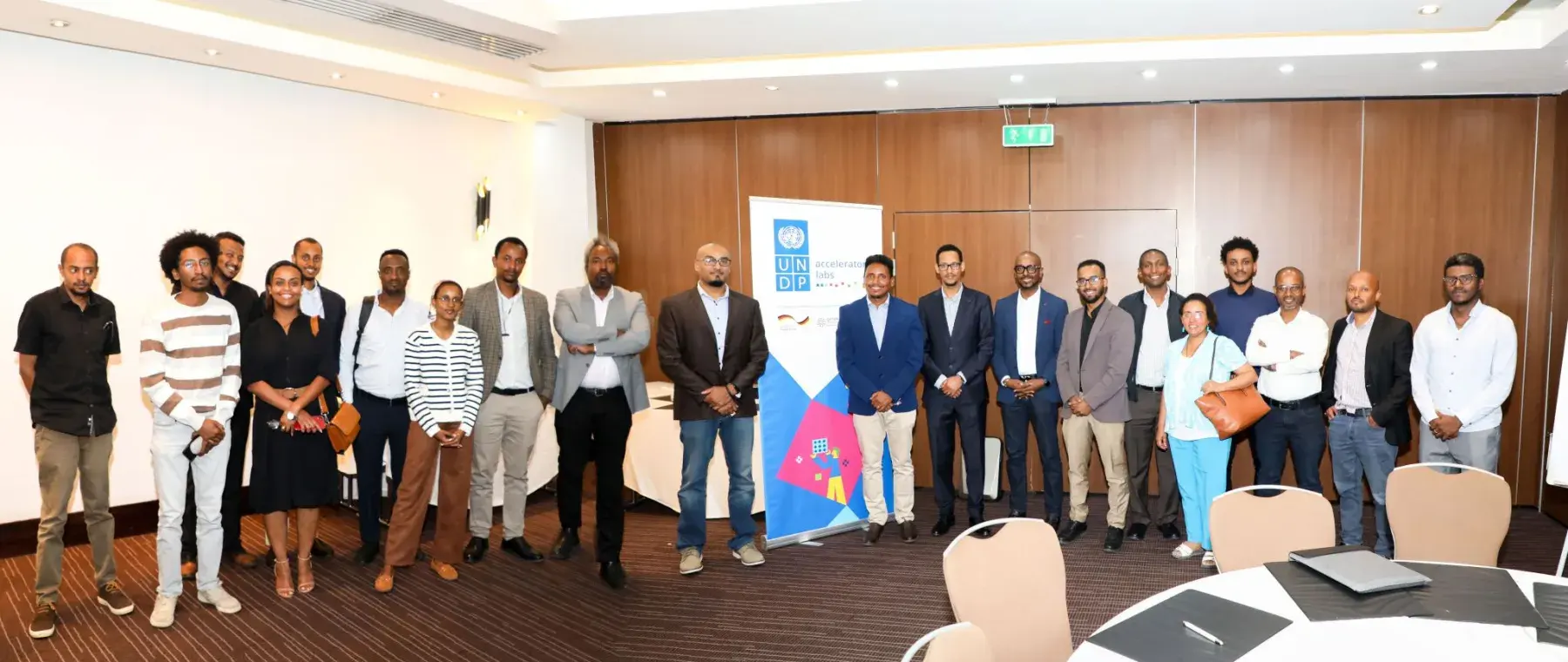
On 5 November 2024, the UNDP Ethiopia Accelerator Lab brought together startups, companies, government, academia and civil society in Addis Ababa for the African AI Hub Strategy Consultation Workshop. The aim was to co-design the strategy of the AI Hub for Sustainable Development, a G7-endorsed initiative co-led by UNDP and Italy's Ministry of Enterprises and Made in Italy, so that it reflects national priorities and the needs of the local AI community.
Andalem took part in the workshop and, as promised there, answered the consultation questionnaire in writing. We sent our answers on 18 November 2024. The photo above shows participants at the workshop.
Local Ecosystem and Partnerships
We described an ecosystem with strong government commitment, including the Ethiopian Artificial Intelligence Institute, the Digital Transformation Council, the Five Million Coders initiative and the regulatory sandbox of the Ethiopian Capital Market Authority. Most AI in use at the time was traditional AI, such as the credit scoring that lets banks and digital lenders offer loans without collateral. Generative AI was still largely untapped.
To build a stronger ecosystem, we argued for:
- Energy and compute: using Ethiopia's renewable energy to attract investment in local GPU clusters, alongside partnerships with cloud providers.
- Multi-year consortium projects: public, private and social partners working together on sector-wide transformations.
- Open data: a national strategy that makes public data available in formats AI systems can use.
- Regulatory sandboxes across sectors, building on the capital market sandbox.
- AI hubs, incentives and access to capital for startups working on national challenges.
- Sovereign AI: models built with local data that understand local languages and context.
On inclusion, our first point was access. In 2024, some frontier models and the cloud credits offered to startups worldwide were not available in Ethiopia, and we asked international organisations to advocate for equal access. We also recommended localising open-source models in Ethiopian languages, with synthetic data where data is scarce, and small, optimised models that run on mobile phones in rural areas.
Impact and Sustainable Development
We linked AI to Ethiopia's main development agendas: Digital Ethiopia, the Homegrown Economic Reform Agenda and the Climate Resilient Green Economy strategy, with the new capital market as a way to fund them. We saw the greatest potential in energy, connectivity, agriculture, healthcare, education and financial services. In capital markets, we described agentic AI that could bring market information and investment options to rural communities, and simulate economic scenarios to help policymakers and investors make better-informed decisions.
To keep AI aligned with the Sustainable Development Goals, we pointed to four concerns: bias in training data, transparency and accountability, data privacy under Ethiopia's Personal Data Protection Proclamation, and the energy that AI consumes, where renewable power gives Ethiopia an advantage.
Policy, Ethics and Barriers
We noted that Ethiopia's national AI strategy was still a draft that had not been opened for public comment, and that no specific steps had yet been taken on generative AI. We argued that local compute and the localisation of generative models should be priorities, so that AI reflects Ethiopia's languages, values and needs.
The barriers we listed from our own experience were:
- Access to frontier models and startup cloud credits.
- Infrastructure: limited high-performance compute and an unreliable power supply in places.
- Awareness and adoption of generative AI in organisations still focused on traditional AI.
- Data in local languages and relevant domains, and clearer rules on its use.
- Regulation: frameworks beyond sandboxes, and faster approvals in sensitive sectors such as finance and healthcare.
- Funding for startups, and closer collaboration between startups, academia, government and investors.
We also suggested that Ethiopia, often called the Land of Origin, could help lead a global, humanity-centred framework for AI alignment and governance, and that the AI Hub could help position Africa as a leader in sustainable and inclusive AI.
Looking Back
These answers describe the situation in late 2024, and some details, such as which models and cloud programmes are available in Ethiopia, may have changed since. Several of the themes run through our later work: renewable energy as a basis for AI infrastructure (see Turning Ethiopia's Renewables into Tokens of Intelligence), sovereign AI, consortium projects, and AderaAI Finance, which applies AI to the capital-market rules of Ethiopia, Kenya and Nigeria (see what we do).
Read the full answers (PDF, 13 pages).