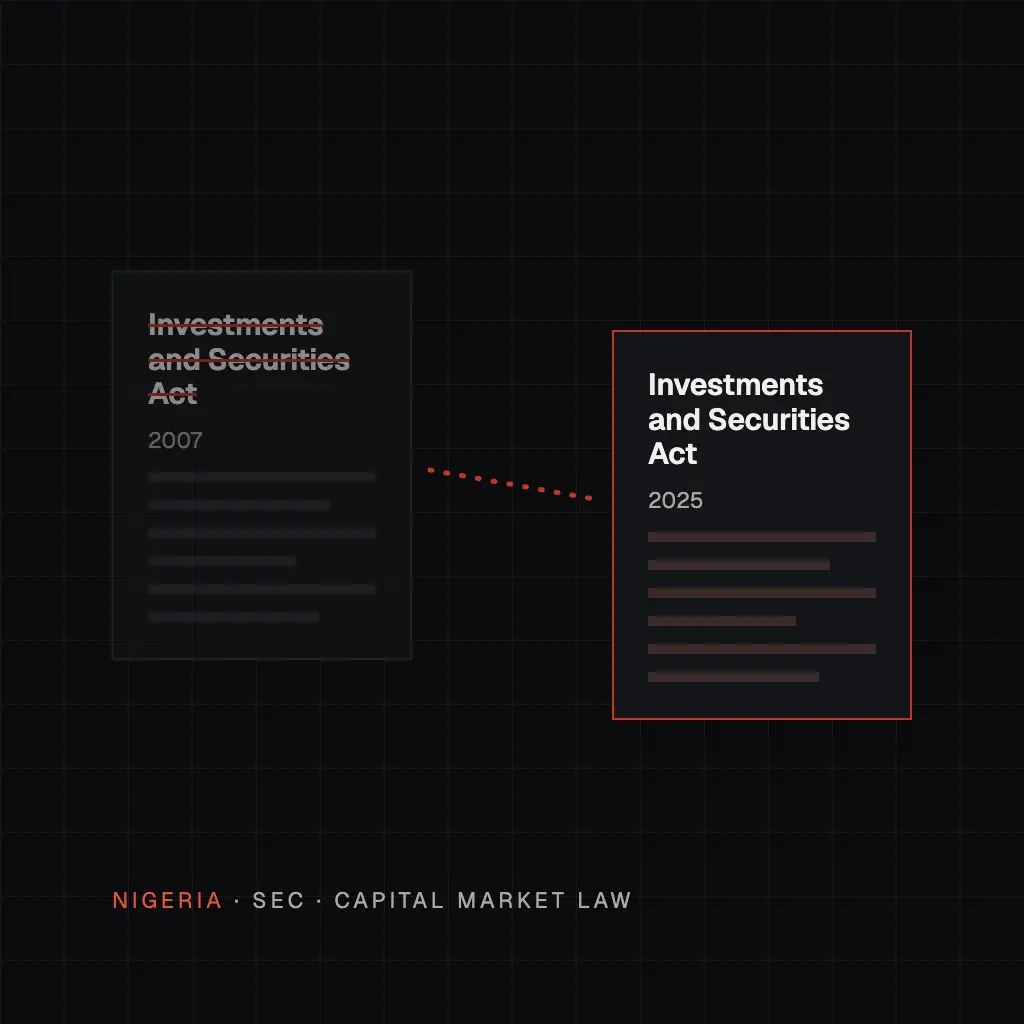
Nigeria has one of Africa’s largest and oldest capital markets, and in 2025 it rewrote the law that governs it. The Investments and Securities Act 2025 (ISA 2025) replaces the Investments and Securities Act 2007, which had governed the market for almost two decades. For anyone working across Ethiopia, Kenya and Nigeria, as we are, it is the starting point for reading Nigeria’s capital market rules. This article summarises what the Act changes, what the Securities and Exchange Commission (SEC) has done since, and how Nigeria’s market is connecting with Ethiopia’s and Kenya’s.
This article describes public sources as of November 2026. It is not legal or investment advice. Check the Act and the SEC’s rules for the exact text.
A new Act
President Bola Tinubu signed ISA 2025 into law in March 2025, repealing the 2007 Act (Andersen; Olisa Agbakoba Legal, via Legal 500). The SEC remains the market’s regulator, with a broader mandate. Among the changes that commentators highlight:
- Digital assets are securities. The Act brings virtual and digital assets within its definition of securities, so the SEC regulates the exchanges, operators and custodians that deal in them (Andersen).
- Ponzi schemes are a crime. The Act explicitly criminalises Ponzi schemes and other unlawful investment schemes, with penalties for those who run or promote them (Legal 500).
- Two kinds of exchange. Securities exchanges are now either composite exchanges, which may list and trade all kinds of securities, or non-composite exchanges, limited to specific asset classes such as commodities or derivatives (Legal 500).
What the SEC has done since
A new Act is followed by new rules. The most significant so far is a reset of how much capital market firms must hold. Under an SEC circular issued on 16 January 2026, the minimum capital for capital market operators rose across brokerage, fund management, fintech, digital assets and market infrastructure (allAfrica, January 2026). As reported:
- Brokers that handle client trades must hold ₦600 million, up from ₦200 million.
- Dealers that trade for their own account need ₦1 billion.
- Digital asset platforms now fall under formal capital rules, with requirements of up to ₦2 billion for exchanges.
- Firms must comply by 30 June 2027, or risk suspension or loss of registration.
The SEC issued further guidance in March 2026 that changed some of the fund manager figures, so check the SEC’s current text for any specific category.
Links across Nigeria, Ethiopia and Kenya
Nigeria’s market is already connecting with Ethiopia’s and Kenya’s, and the links are being built by market participants themselves.
- NGX Group and Ethiopia. In April 2024, before the Ethiopian Securities Exchange (ESX) opened, Nigerian Exchange Group (NGX Group) invested in it alongside FSD Africa and the Trade and Development Bank Group, and said it would provide ongoing technical assistance to the new exchange (NGX Group, 7 April 2024). The stake was reported at the time as 5%, with the possibility of rising to 10% with board approval (Bloomberg, 8 April 2024). NGX Group’s 2024 financial statements put its holding at 10% of the ESX’s shares (Moneycentral, March 2025).
- NGX Group and Kenya. In September 2026, NGX Group and the Nairobi Securities Exchange (NSE) met in Nairobi to explore closer collaboration, including companies listing in more than one African market (NGX Group, 29 September 2026). On 16 November 2026, NGX Group announced that it had acquired 10% of the NSE (NGX Group, 16 November 2026).
- A Nigerian investment bank in Ethiopia. On 5 June 2026 the Ethiopian Capital Market Authority licensed United Capital Financial Services PLC, a subsidiary of Nigeria’s United Capital Group, as an investment bank. It was the first foreign investment bank to establish a licensed subsidiary in Ethiopia (StockMarket.et).
With these steps, Nigeria’s exchange group now holds a stake in both the youngest exchange in the region and one of its oldest, and a Nigerian investment bank is now licensed in Ethiopia. None of this required a new treaty between governments. Exchanges, investment banks and their regulators are building regional integration from the ground up, one investment, licence and listing at a time. We hope to see more of it. Ethiopia’s link with Kenya follows the same pattern (see our article on the ESX-NSE agreement and cross-listing).
What to watch
- Further SEC rules made under ISA 2025, especially for digital assets and the new classes of exchange.
- How firms meet the June 2027 capital deadline: through new capital, mergers, or narrower licences.
- Whether NGX Group’s stakes in the ESX and the NSE lead to cross-listings or joint products, which would also depend on each country’s rules for foreign issuers and investors.
- More licences for foreign capital market firms in Ethiopia, and more firms working across the three markets.
Why this matters to us
A new primary law changes how every rule beneath it should be read. Definitions move, powers shift, and older guidance has to be checked against the new Act before anyone relies on it. Tracking those changes, and linking each reading to the exact provision and version it relies on, is the work we are building AderaAI Finance to support across Ethiopia, Kenya and Nigeria.