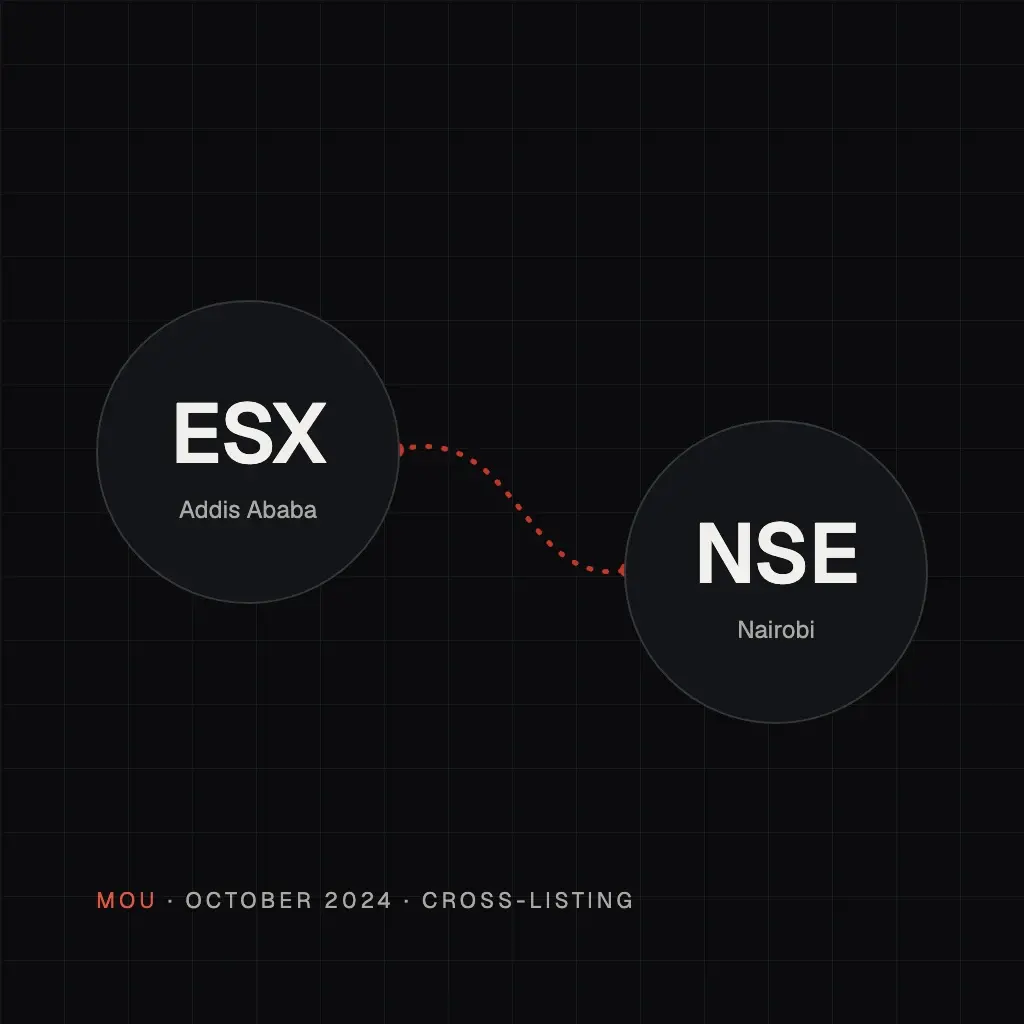
Ethiopia and Kenya are two of East Africa’s largest economies, and for the first time both have a working securities exchange. In October 2024, three months before the Ethiopian Securities Exchange (ESX) opened for trading, it signed a memorandum of understanding (MoU) with the Nairobi Securities Exchange (NSE) and the iCapital Africa Institute. Press coverage at the time described it as a step toward companies listing on both exchanges. This article looks at what the agreement says, what the rules on each side would require for a cross-listing, and what to watch next.
This article describes public sources as of November 2026. It is not legal or investment advice.
What was signed
The MoU is between the two exchanges and iCapital Africa Institute; it is not an agreement between the countries’ regulators. According to the ESX announcement, the partnership aims to support the integration of the two capital markets, with a focus on knowledge exchange, capacity building and the promotion of cross-border investment. It names joint training for market participants, work toward a strong regulatory framework, and new financial products for investors in both countries.
The announcement does not use the word “cross-listing”. That possibility comes from coverage of the signing, which reported that the agreement could let companies list on both exchanges (Shega, 18 October 2024). As of November 2026, we have found no public record of a company cross-listed between the two exchanges.
What Kenya’s rules require
Listing in Kenya is governed by the Capital Markets (Public Offers, Listings and Disclosures) Regulations, 2023, supervised by the Capital Markets Authority (CMA). The NSE summarises the requirements for a company already listed abroad on its foreign issuer requirements page:
- Two years on the home exchange. The company must have been listed on a foreign securities exchange for at least two years before applying to cross-list in Kenya.
- A recognised home exchange. The home exchange must be recognised by the CMA.
- No-objection certificates. The company needs a certificate from its home exchange and from every relevant foreign regulator. For an Ethiopian company, that would mean the ESX and the Ethiopian Capital Market Authority (ECMA).
- Good standing. The company must stay in good standing on its home exchange, and any suspension or delisting must be reported to the CMA immediately.
- The same eligibility tests as local companies. It must meet the requirements of the NSE segment it joins (Main or SME). The CMA may allow reduced disclosure, case by case, for companies already listed on a recognised foreign exchange.
The first rule sets a clear earliest date. The ESX opened on 10 January 2025, with Wegagen Bank as its first listing (VOA). On a plain reading of the two-year rule, no ESX-listed company can apply to cross-list in Nairobi before January 2027, and companies that listed later, such as Ethio Telecom in May 2026, would wait longer.
What the Ethiopian side still needs
A cross-listing in either direction also depends on Ethiopian rules that are still being written.
- Kenyan companies on the ESX. The ESX Rulebook, 2024 sets the listing requirements for its Main Board and Growth Board, and ECMA approves public offers. How a company already listed abroad would list in Addis Ababa, and on what terms, is something the two exchanges and ECMA would need to settle.
- Foreign investors. Cross-listing matters most if investors in each country can buy the other’s shares. ECMA has been preparing a foreign portfolio investment framework, described in March 2026 as close to approval (Capital Ethiopia), and published a draft Foreign Portfolio Investment Regulation on 29 September 2026 (ECMA, laws and regulation). At a public consultation in Addis Ababa on 26 October 2026, the draft was reported to limit a single foreign portfolio investor to 10% of a listed company (15% for certain public institutions, with ECMA’s approval) and all foreign portfolio investors together to 30% (The Reporter, 27 October 2026). Until a final text is published, the terms for foreign investors remain open.
- Moving money. Buying, selling and receiving dividends across the border also runs through the National Bank of Ethiopia’s foreign exchange rules, which govern how investors can bring money in and send proceeds out.
What to watch
- Publication of Ethiopia’s foreign portfolio investment regulation, and its final ownership limits.
- Whether the CMA recognises the ESX as a foreign exchange for cross-listing purposes.
- January 2027, when the first ESX-listed companies reach two years on the exchange.
- The first application from a company in either country, which would show how the two exchanges and regulators coordinate in practice.
Why this matters to us
Cross-listing is a clear example of a question that cannot be answered from one country’s rules alone. A company or adviser has to read the Kenyan regulations, the NSE’s requirements, the ESX Rulebook, ECMA’s directives and the National Bank of Ethiopia’s foreign exchange rules side by side, and keep track as each one changes. Comparing rules across Ethiopia, Kenya and Nigeria, with every reading linked to its source, is the work we are building AderaAI Finance to support.